On My Watch

The-Canadian-1926-image-6

I was so excited for my eldest to return from his three-month Israel adventure, that I had not anticipated how life would change upon his return. While away, he turned eighteen, so there went the provisional driver’s license with it’s midnight curfew.  I didn’t think about the mild unease with which I would fall asleep the nights that he is out. Who knew that the sweetest sound in the world is the garage door opening, announcing that he has returned home? I don’t even care that the dog barks – it’s as if he too rejoices that the teenager is home safe and sound.

My boy left as a single fellow and returned with a girlfriend. How delightful, yet odd to see him with a significant other and to hear him use the royal “we” when talking about  he and his gal-pal.

Last week I accompanied him, probably for the last time, to the pediatrician for the annual check-up. Before I left the room for their private exam and discussion, the doctor was talking about routine shots and upcoming immunizations. I was aware that he was talking to my son, not me; his gaze had been averted to the other adult – his patient – in the room. I was just a bystander. Appropriate, yes, but I felt a little adrift as I was gently cast aside.

Then there is the other single, yet attached, man in my life – my father. I go to sleep worrying about my young man and wake up thinking about my older man. While he is in the country and nearby, I make sure to call him each morning. Living in a house full of people, I take for granted that people will know whether I have woken up or not. When he is in Israel, I am grateful for his lady friend to watch out for him.

As my father empties his house and prepares to leave his life in the U.S., all of his mail and packages are delivered to my house.

“I feel like I’m Dad’s front desk,” I told my sister.

He regularly calls to tell me which things are going to be delivered, when to expect them, and then calls to see if they came. It’s charming and amusing. He’s on my watch, and I’m happy to keep him happy.

I have to admit that sometimes I feel acutely aware of my sense of responsibility and the loss of even the illusion of control. Piled on top of taking care of the other people and things in my life, I am wound a little tighter. This month my father will return to Israel and my son will go work at a sleep away camp. I will breathe a small sigh of relief and wish them both a wonderful time as I look forward to a good night’s sleep – at least for a little while.



A Glimmer of Hope

glimmer-of-hope1

Something unexpected happened while we were in Israel recently. We were having a Passover Seder in a banquet hall with several other families from our Jewish day school. There was a lull in the evening as people were eating and going back and forth to the buffet. Out of the corner of my eye, I noticed my sixteen-year-old son with special needs sitting on a sofa talking to someone. Not just a family member or a family friend, but a girl, and a teenage girl at that. A lovely younger sister of my older son’s classmates, with health challenges and issues of her own. What struck me was that they actually seemed to be engaged in conversation – something that is generally difficult for my son to sustain.

It was so adorable – it almost made me weep.

“What’d you talk about?” his siblings and I grilled him afterwards.

“We actually had a lot in common,” he said matter of factly. “We talked about tv and movies.” Ah, that made sense as these are some of his favorite things to discuss.

Still, I was touched at the sweetness of the interaction which allowed me to see my son in a different light – as a young man with the possibility of courtship. I felt as if I was channeling my mother and grandmother when I described what, to me, was a momentous event to my friends…”It was just darling,” I gushed.

The evening passed and the moment faded into a warm memory. Until I received an email from the young lady’s mother saying that her daughter wanted to go see a movie with my son. Be still my heart! I was elated. His life is rich with family, family friends, friendly professionals, and lovely volunteers. But it is rare that he gets invited to do something socially with a good old-fashioned friend.

“I want to go,” he eagerly stated.

“Do you know how to behave like a gentleman?” I joked with him.

He assured me that yes, he did. I was giddy with anticipation of the big “date,” although my son did not like to be teased about it and of course viewed it for what it was – going to the movies with a friend, who happens to be a girl. I showed restraint around him, spilling over with excitement to my sister, father and girlfriends.

It turned out to be a lovely, uneventful outing. After their dads helped buy the tickets, the two friends sat and watched a movie while happily munching on popcorn. Truth be told, my son hogged the popcorn, his companion reported when we picked them up.

“It was just so delicious,” he sheepishly admitted.

So much for his gentlemanly behavior. He acted like a typical teenager – rather than being thoroughly annoyed by this fact, I was overjoyed. Next time we’ll spring for the jumbo tub of popcorn. I can’t wait.


“It’s Appropriate”

kids-screen-time-tv

Has this ever happened to you? One of your children is watching something on a screen that seems questionable to you. You ask if it is appropriate for them. They assure you that, yes, it is appropriate.

“Oh. Okay,” you say.

You know they say this because they want you to go away and leave them in peace. You want the same thing, so you choose to believe them because sometimes you don’t feel like taking the time to investigate if it’s truly appropriate. Sure – I can count on my child to know what’s appropriate and what’s not, can’t I? The kids and I would agree on certain things that are clearly not appropriate, such as highly sexual content or gory violence – they wouldn’t want to watch these things anyway (not yet, at least.) It’s all the other things (like bad language, mature themes, silly reality shows) where the line is not always so clear.

Sometimes things are inappropriate but in the opposite direction – not mature enough. Take for instance my 16-year-old son with special needs. He has a penchant for watching shows that some might say are too young for him. I used to tell him he is too old to watch these shows.

“But I like them,” he told me.

Sigh. He likes them. Who am I to force him to watch shows that he doesn’t really get or enjoy, just because they are more age appropriate? For me, there’s a fine line between expecting him to act his age and allowing him to be how God made him. Where is the perfect balance? I’m always looking for it.

My daughter recently reported that this brother was watching “Family Guy.” Oh good, my husband and I thought – that’s semi-appropriate for a teenage boy. Then she told us that it was really a cover for him to watch a children’s show on the computer – he too clearly understands the whole “It’s Appropriate” game. Too bad this cognitive ability doesn’t actually transfer to age-appropriate television for him, but oh well. He did participate in a recent “Simpsons”-fest with his cousins, keeping him somewhat in the adolescent TV loop.

My daughter chastised me for allowing her brother to watch “baby” shows.

“Really? Do I need a critique of my parenting from you?” I asked.

Let me just say that she loves “Dance Moms” and God-knows what other shows that some may say are inappropriate for an 11-year-old girl. It’s amusing to me that my youngest thinks she is the maven of appropriate material. When she was nine she picked the song “Mean” by Taylor Swift to sing in a recital. It’s a great song. We both thought the tune was catchy but neither of us paid much attention to the words. I just thought she was so adorable. As I sat there watching her, I realized the song is about an abusive relationship and my stomach dropped to my toes.

Maybe not my best call in this grey area we call parenting, but the world didn’t come to an end. The video of her singing still makes me smile to this day. Is that really so inappropriate?


Checking In

checking in

My graduated senior has been gone for just over a month on his grand “Capstone” trip to Israel and Eastern Europe. He is with 80 of his classmates and by all accounts seems to be having an amazing time. I rarely call him and only occasionally text him. I am comfortable letting him explore life and experience it separate from me. Sure, I miss him but feel glad he is out doing wonderful things and not sitting in my basement.

Something interesting seems to be happening, however – the teenager who wanted to be with his friends 99% of the time and only spent occasional moments with me now actually reaches out to check in with home base occasionally. And not just to tell me he is fine or to ask for money. He wants to share his experiences with me – imagine that. I’m pleasantly surprised and happy to hear from him.

As you would imagine, learning about and seeing the sites where the atrocities of the Holocaust occurred is emotional for anyone. An almost-18-year-old, on the cusp of adulthood is no exception. He is in the throes of forming his identity as a Jewish young man and finding his place in the world, while looking at the past and thinking about the future. Heavy stuff, for sure.

He face-timed me from Poland so he could tell me everything he had done and seen. He told me that one of his teachers was awesome, and that he found him so “compelling.” Compelling? Really? When did he start using that word? We had a great conversation as he tried to capture his experience for me. I hung up after twenty minutes and felt a moment of complete bliss. I knew it wouldn’t last, but in that moment I felt joyful about the man my son is becoming. He didn’t sound like a spoiled, entitled teenager but rather an adult who feels deeply and is interested in learning about his history, culture, and religion.

A few days later he texted me pictures from Prague with the caption “absolutely stunning.” I have never heard my son use the word “stunning” or known him to be aware of, much less be so moved by landscape in his life. It’s quite a kick to see your offspring become someone who you can picture yourself hanging out with and it’s a welcome relief to have a reciprocal conversation full of adult topics and not just housekeeping issues.

I have no delusions that the road ahead will be perfect and rosy. My son is a typical young man and we are typical parents. I at least feel optimistic about the future. Hopeful, I guess. It beats feeling gloomy. So much of parenting is full of angst and agitation – I’ll take the good moments when they come my way and savor them. I  hope he keeps moving forward and checking back in.


Soiling the Nest

Soiling the Nest

My son’s departure date is fast approaching. He just graduated from high school and is going on a three-month learning experience in Israel and Eastern Europe. I vacillate between being irritated by him/looking forward to his leaving and adoring him/being excited for his adventure/feeling a smidge sad that he’s going. Just the other day he came back from a four-day youth group convention out of town. It was just starting to snow and I was cooking delicious treats, looking forward to being snowed in with my family.

“I’m going to spend the night at my friend’s house,” he announced, “I haven’t seen my buddies in five days.”

“Okaaay, but you’re going to spend three months with them,” I reminded him. I had hoped he would want to spend some time with us, and then felt a little pathetic, like a dog waiting for scraps of attention. I had a brief pity party and then I remembered being seventeen. I preferred my friends’ company to my family’s for a long time. My son has clearly crossed the line of wanting to be with his friends more than with his family. I know it’s normal and appropriate, but sometimes it bugs me. How could he not want to be with us? Aren’t we as awesome as we think we are? I also find annoying his occasional intolerance of my benign inquiries, like “what are your plans for the day?” I’m an awful, intrusive mother – obviously.

I was venting to my sister about my mixed emotions. “Sounds like he’s soiling the nest,” she said.

Precisely. I have heard about this phenomenon and am now experiencing it firsthand. Obviously, he is not literally soiling our home. Psychologists say graduating seniors may struggle with vulnerability and self-doubt about being equipped to fling themselves into the daunting unknowns of the next stage of life.  They cannot directly confront their sadness about saying good-bye to the familiar “knowns” of childhood. How could they take flight, so weighed down by such emotional burdens? Better to fling off all that drag and fixate only on enhancing the “good riddance” of their good-byes. Better yet, why not soil the nest on the way out, “gifting” US with an easier “good-riddance to you too”  good-bye ?!  The more toxic and messy they are, the easier transitioning to the next phase will be, for them, and for us.  I know we’ve got a fairly mild case of nest soiling. My son is not toxic or even particularly messy. He is generally sweet and thoughtful. But I gotta say – I’ll be kind of glad when he goes. This waiting period is hard. Ripping the band-aid off seems the better way to go.

The parties are over, the important talks have been had, with emphasis on “Don’t do anything to embarrass yourself, your family or your school.” Let’s face it – it’s about him, but it’s also about us – the parents. No big to-do or send-off as we cross the line of this next milestone in the life of our family.

There have already been inquiries from his siblings about the use of his empty bedroom. Looks like some nest-reorganizing is in our future. At least until what’s-his-name comes back.


Look Away

Looking_away__by_dontpromiseme

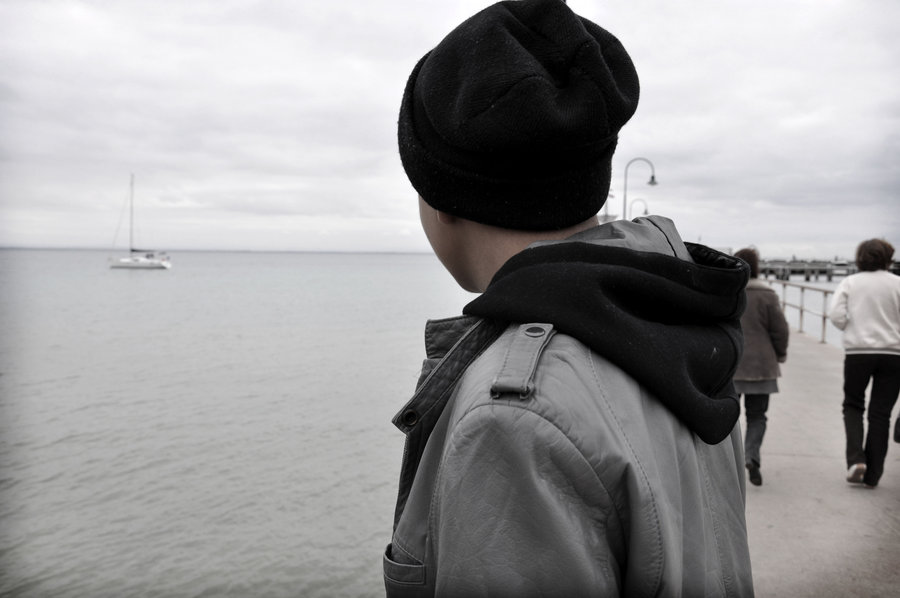
My eldest is leaving the house this month. Seniors at his school graduate in February and go on a three-month trip to Israel with a side-tour to Eastern Europe. He’ll leave a vacant bedroom and the family “hot-seat.” When you have several children, a parent’s attention shifts from child to child depending on who’s the neediest at the time. Our family configuration will change with the oldest gone. I have mixed emotions but mostly I’m happy for him as he sets off for the next phase of his life. Full disclosure – I’m also sad to lose the extra driver in my family. He’s been driving his 13-year-old brother to school for the past year, a job which I now get to resume. I enjoyed the hiatus but am intrigued by the opportunities this presents. I was driving my two youngest to school recently and asked my son if he and his brother talked much when they drove to school together.

“Some,” he said, “but usually we’re pretty tired.”

“Well, now you and I will get lots of time to talk,” I enthusiastically said.

In my rear view mirror, this prompted an excellent, textbook eye-roll from my daughter. I knew I was on to something.

With the eldest leaving the nest, I can turn my attention to the other children in the house. We’re done with driving lessons, college entrance exams, the college search, etc with the first-born. Sure, there will be other things we need to teach him but from a different vantage point. It won’t be that daily, up-close-in-your-face kind of parenting.

It’s the lucky children who remain in the house who are the recipients of our wisdom and attention, whether they want it or not. Next in the birth order in our family is our son with special needs. He gets a lot of attention for his health issues – he has a feeding tube and a medication schedule, but truthfully – as long as he is relatively healthy and happy our attention stops there. It’s the third child who is next in line for our scrutiny. I’m sure he has no idea what’s in store for him. I’m looking forward to getting to know this creature again, now that he’s smack in the middle of the teenage morphing years. Maybe now that I’ve practiced my parenting skills on my eldest, I can perfect them with this child. Or maybe I’ve learned what’s important and I just won’t care about the same stuff. It’s kind of like a weird science experiment – so many variables and hypotheses.

Strangely, I find myself thinking of the swimming pool of all places. For a few years, I volunteered as a “stroke and turn” judge for our neighborhood summer swim team. I had to scan three of the six lanes of the pool to make sure the swimmers were swimming “legally.” If there happened to be only one swimmer and two empty lanes, we were taught to keep scanning as if there were three swimmers so the one swimmer didn’t have a disadvantage of being watched every moment. Each swimmer should benefit from the judge’s gaze being averted.

This struck me as a great metaphor for parenting. I don’t think it serves my children well to have my attention every minute, all the time. I am constantly scanning their lives while deliberately looking away occasionally. Nobody wants to be watched all the time.

By looking away, I may miss the occasional “illegal” strokes or turns in my kids’ lives. Let’s hope my parental scanner will pick up the stuff that really counts.

Cave-Woman

caving

Many people begin the parenting experience by making grand proclamations about how they will raise their offspring. Things like, “my child will only watch educational television,” or “my child will only eat healthy foods.”

Then life happens and those strong feelings get tempered, those little babies become people who speak and have opinions, and parents learn to juggle their wants and desires with those of their children.

Sometimes we get beaten down and cave to their incessant demands. In my house, this has played out recently in the form of an iPhone. My husband and I were so proud of ourselves for holding out and not buying an iPhone for our oldest child until he was seventeen, which was last year. “What does he need it for?” we asked. “He has a perfectly good phone. And an iTouch.” Being the dutiful firstborn, he accepted his fate and didn’t press too hard on the subject. So we eventually relented, telling ourselves that he’ll be in college soon.

Ah, but it’s a slippery slope. Now our 13-year-old is lobbying hard. I find that I just don’t feel as strongly this time as I did with our eldest. Maybe because smartphones have become the norm. Maybe because he never seems to have his plain, old phone charged or with him when I need to reach him.

“If we get him an iPhone, it will no doubt be attached to his body and fully charged and therefore he would be reachable, right?” I asked my friend, who also has a 13-year-old boy.

“Absolutely,” she said, “My son’s phone is never dead. I could be dead, but his phone – never,” she chuckled.

Yep, I see an iPhone in the future for this son, once I negotiate this with my husband. Poor guy, he recently attempted to use his legal prowess with our daughter on the very serious subject of her birthday present. He called me one day after dropping her off at school.

“I caved,” he said.

“Oh? On what?” I asked.

“A trampoline. For her birthday,” he announced, defeated.

I’m happy when my husband occasionally caves. Since I spend more time with the kids, I am the recipient of most of the asking, whining, and begging so of course I cave more than he does. I was glad to see my daughter go for his weak spot – it’s a good skill for her to learn. In his defense, he held out for well over a year before caving.

So the trampoline will grace our backyard, where the dog roams too. I’m the one who caved on the dog. I guess we’re even, for now.

Have we lost control or do the things we care about change over time? Once we were rigid about bedtime – now it’s only the eleven-year-old who’s asleep before us. I was talking with a friend about this.

“I’ve lost control of that, among many other things,” she said and went on to tell me that her neighbor has noticed over the years that the lights in their house stay on later and later. The whole world apparently notices our loss of control. What’s the neighbor doing up so late anyway?

I like to tell myself that I don’t cave on the things that I really care about like being a good person and having good manners. Oh, and being a good student – although I confess that I leave the schoolwork to the kids and their teachers. I assume they are doing well if I don’t hear anything negative from the school. I guess I’ve sort of caved on that too.

Ultimately my children will be the captain of their ships and will have to do their own navigating. In the meantime, I’m just trying to have smooth sailing.


My Own American Werewolf

002800americanwerewolflond

I used to have a darling third child. He was born six weeks premature but quickly exploded into a blonde dumpling – an anomaly in my house of brunettes. He was an adorable child – fun, funny with a delightful disposition. He was a pleaser and very affectionate, so much so that my husband and I nicknamed him “The Drape” because he would hang on us at any opportunity. A touch smothering but basically adorable.

Now he’s thirteen. His mood generally morose, he is most often found with his head attached to headphones and watching television shows on the computer screen. I have to remind him to do the things he’s supposed to do –  homework, shower, eating, etc. In all of our interactions he’s either snippy, spacey, or both.

“Huh?” seems to be his bewildered response to every inquiry.

I know this is the norm for an adolescent. What sets this child apart in our household is the rapid transformation from adored child to exasperating teenager.

It is my experience that when a child irks one parent, the other parent is able to swoop in and valiantly play defense attorney for the young offender – the champion of the poor, misunderstood child. I think that’s part of evolution, so we don’t kill our young.

For me, adolescence can be summed up by the 1980’s movie, An American Werewolf in London, where the main character, an adorably boyish looking twenty-something, periodically morphs into a terrifying werewolf. Our children, once so pure and pristine suddenly begin “the change” into adulthood. Their faces temporarily appear out of proportion, they get acne, their limbs are gangly, their hormones surge, until they become a creature that we hardly recognize. Oh, how I long for my cute little boy.

I am fairly confident that he will come out okay on the other side of adolescence, if I don’t kill him first. I see little glimmers of hope from time to time – watching him laughing with friends or playing charmingly with little kids. Deep down the sweet little boy is still there. Even werewolves must love their mothers, right?

It is clear to me now that my experience of adolescence as a parent to three boys has all been one giant preview to the main event that awaits me in the near future. My daughter turns eleven next month.

Pray for me.

Bittersweet Sixteen

sweet-16-birthday-cakes-pictures

My son with special needs turned sixteen last week. My father reminded me to say a prayer, expressing gratitude for having raised him to this point in time. I am thankful that he is happy, loved, that he walks and talks.

It is, however, bittersweet. Oddly enough, I am most sad that he is not on his way to driving a car – the highlight of turning sixteen for most teenagers in the United States. The ability to leave the house and your family and find your own way is liberating.  I still love to hop in my car and drive away sometimes. Except this time I’m running away from my children. Sweet separation. My eldest son is seventeen and he drives. His little sister once asked where her brother, the new driver, was.

“Out,” I answered.

“Why?” she asked.

“Because he can,” I told her.

I vividly recall my elation at getting my license and the incredible freedom I felt. I remember going “out” as often as I could, to that elusive place where parents can’t find you. Nowadays children can’t be as unavailable as they’d probably like, poor things, because of the homing devices that are their cell phones.

It makes me sad that my second son cannot go “out,” although he doesn’t seem to want to. He is not focused at all on the fact that he is not on the driving trajectory. In fact, he would probably be happy to stay “in” for the rest of his life. He’s happy surrounded by his family and his beloved video games. It’s tempting to let him stay in forever, to keep him safe and sound.

“Maybe he could try taking the driver’s ed course, to see if he could even pass?” I mused to my husband and other children.

They all dismissed the idea as ludicrous. He would be a danger to himself and others, they argued. His lack of attention to the world around him could have disastrous consequences. Are we selling him short? Am I crazy and deluded? Maybe a little.

It’s part of the ongoing see-saw of raising a differently-abled child. I am grateful for the things he is able to do but the grief for what he can’t do lurks in the background. His brothers are tall, strapping young men like their father. I encourage this son to consume as many calories as he can, so that maybe he can be as tall as his five-foot-four-inch mother. I cling to things I may have a touch of control over, to maintain an illusion of normalcy.

There is a popular essay which is given to many parents when they have a disabled child. It is called “Welcome to Holland.” The gist of it is that you were planning a trip to Italy and were shocked to find you arrived in Holland. Once getting over your disappointment at landing at the wrong destination, you look around and discover the beautiful things in Holland. It’s a lovely metaphor to try to make you feel better about the immense sadness and disappointment you feel when you have a less-than-perfect child.

It works for a while, perhaps getting you through the early years of crushing hardship and disbelief. I have a group of women friends who I met in a support group ten years ago, all who have disabled children. My “Special Mom” friends, I call them.

“Holland sucks,” we wholeheartedly agree.

But here we are. We strive to savor the sweet and tolerate the bittersweet.

So Happy Birthday to my young man. Who cares that driving’s not in your future? I’ll teach you how to ride the bus.


“Not Guilty”

notguilty

My husband is a very competent, caring person. While I was away on a recent trip to Israel, he managed to successfully get all four of our children off to camp. Although this is an impressive feat, let’s be real – yours truly made the fifty trips to Target and did the actual packing prior to my trip.

I called him on my last day in Israel as he was driving our son with special needs, the remaining child at home,  to sleep-away camp.

“Ben had a bad day yesterday,” he reported.

“I’m sorry,” I said.

“It’s not your fault,” he replied.

I appreciated his kindness. I felt sad that my son had a bad day and that my husband had to deal with the unpleasantness for several hours. Usually I am the one at home who has to deal with these episodes.  I am thankful he’s a hands-on dad. And that he didn’t try to make me feel bad for being away from home.

I hung up the phone and told my friends what had happened.

“I don’t feel guilty,” I explained, “I just feel badly for them.”

“What a novel concept,” one of them said, as if a light bulb had gone off over her head.

Feeling guilt, like so many other things in life, is a choice, and it is one that I don’t often choose to make.  I come by a guilt-free disposition naturally. My family doesn’t do the stereotypical “Jewish” guilt. In fact I hate when people act like guilt is part of our heritage.  Am I perfect? No. Do I make mistakes? Yes. I try to learn from them and do better the next time. Done. Let’s move on people, there is nothing to see here.

Women often feel self-centered or selfish when they do something for themselves or not with their families. I say nay-nay. In the blink of an eye my kids will be gone. I want to keep growing and enjoying life in ways that are sometimes independent of my family. I don’t want to get mired in feeling badly for what I have or have not done.

When I got home, my husband was quite proud of how he managed all of the household duties and challenges on top of his job. It reminded me of the time he came home from a business trip and my chest heaved with pride having fixed a broken toilet, as if it was a major engineering feat. We both praised each other even though I’m pretty sure each of us was secretly thinking, “Do you want a freakin’ medal?”

I returned from my trip energized. A whole week of being Susan, not someone’s wife or mother, was refreshing.

Selfish? I don’t think so. Self-preservation is more like it.